
Vital Signs: Safe Sleep for Babies
Eliminating hazards
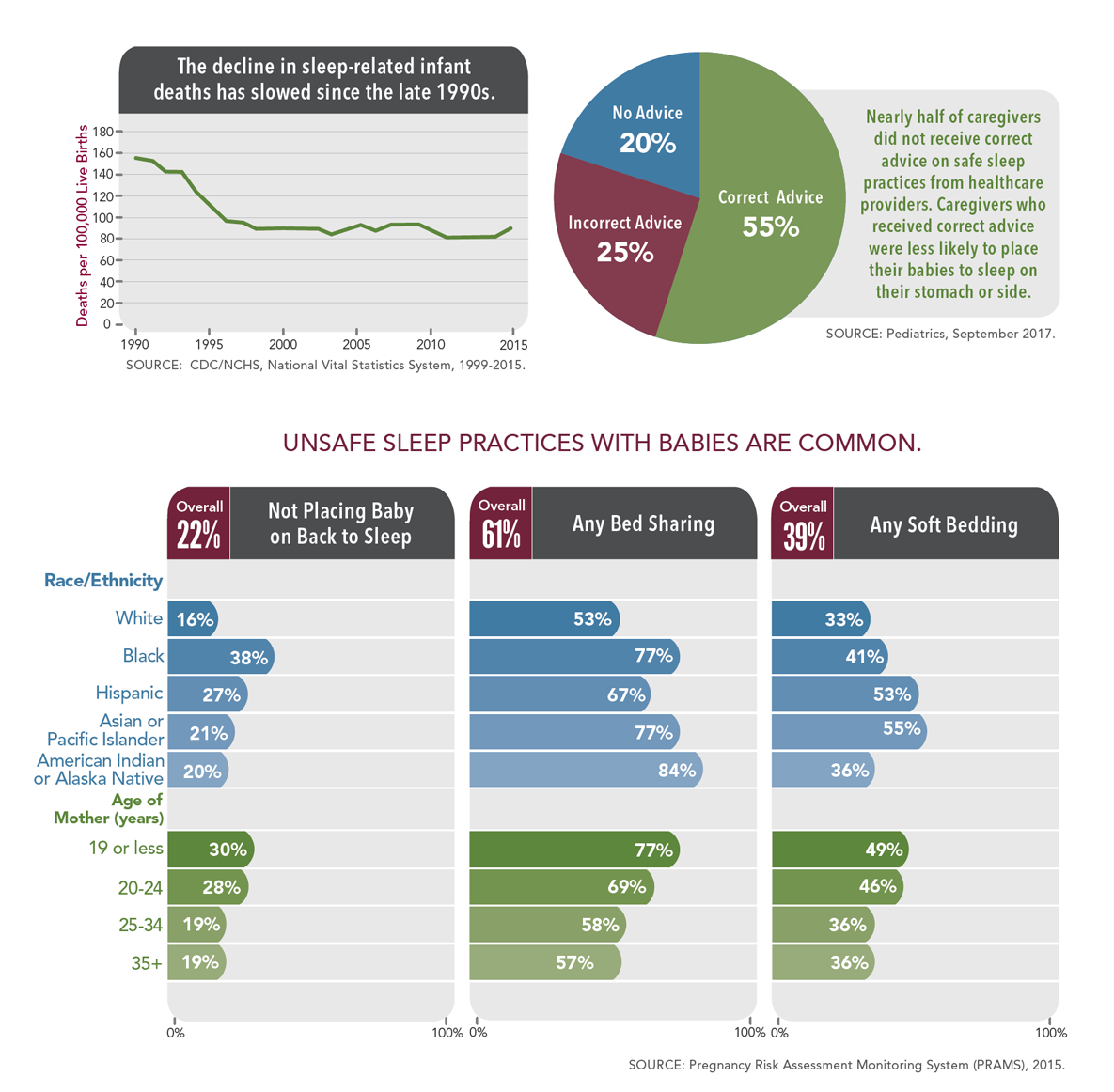
The decline in sleep-related infant deaths has slowed since the late 1990s.
| Year | Deaths per 100,000 live births |
| 1990 | 154.6 |
| 1991 | 153.1 |
| 1992 | 143.1 |
| 1993 | 142.4 |
| 1994 | 125.9 |
| 1995 | 113.1 |
| 1996 | 101.4 |
| 1997 | 99.2 |
| 1998 | 94.5 |
| 1999 | 93.9 |
| 2000 | 94.4 |
| 2001 | 94.6 |
| 2002 | 94.5 |
| 2003 | 89.7 |
| 2004 | 92.4 |
| 2005 | 97.5 |
| 2006 | 93 |
| 2007 | 97.5 |
| 2008 | 99 |
| 2009 | 97.1 |
| 2010 | 90.3 |
| 2011 | 86.1 |
| 2012 | 87.6 |
| 2013 | 87.3 |
| 2014 | 87.5 |
| 2015 | 92.6 |
SOURCE: CDC/NCHS, National Vital Statistics System, 1999-2015.
Twenty-five percent of caregivers received incorrect advice on safe sleep practices from healthcare providers. Twenty percent of caregivers received no advice from healthcare providers. Caregivers who received correct advice (55%) were less likely to place their babies to sleep on their stomach or side.
SOURCE: Pediatrics, September 2017.
Unsafe sleep practices with babies are common.
| Not Placing Baby on Back to Sleep | Any Bed Sharing | Any Soft Bedding | |
| Overall | 22 | 61 | 39 |
| Race/Ethnicity | |||
| White | 16 | 53 | 33 |
| Black | 38 | 77 | 41 |
| Hispanic | 27 | 67 | 53 |
| Asian or Pacific Islander | 21 | 77 | 55 |
| American Indian or Alaska Native | 20 | 84 | 36 |
| Age of Mother (years) | |||
| 19 or less | 30 | 77 | 49 |
| 20-24 | 28 | 69 | 46 |
| 25-34 | 19 | 58 | 36 |
| 35+ | 19 | 57 | 36 |
SOURCE: Pregnancy Risk Assessment Monitoring System (PRAMS), 2015
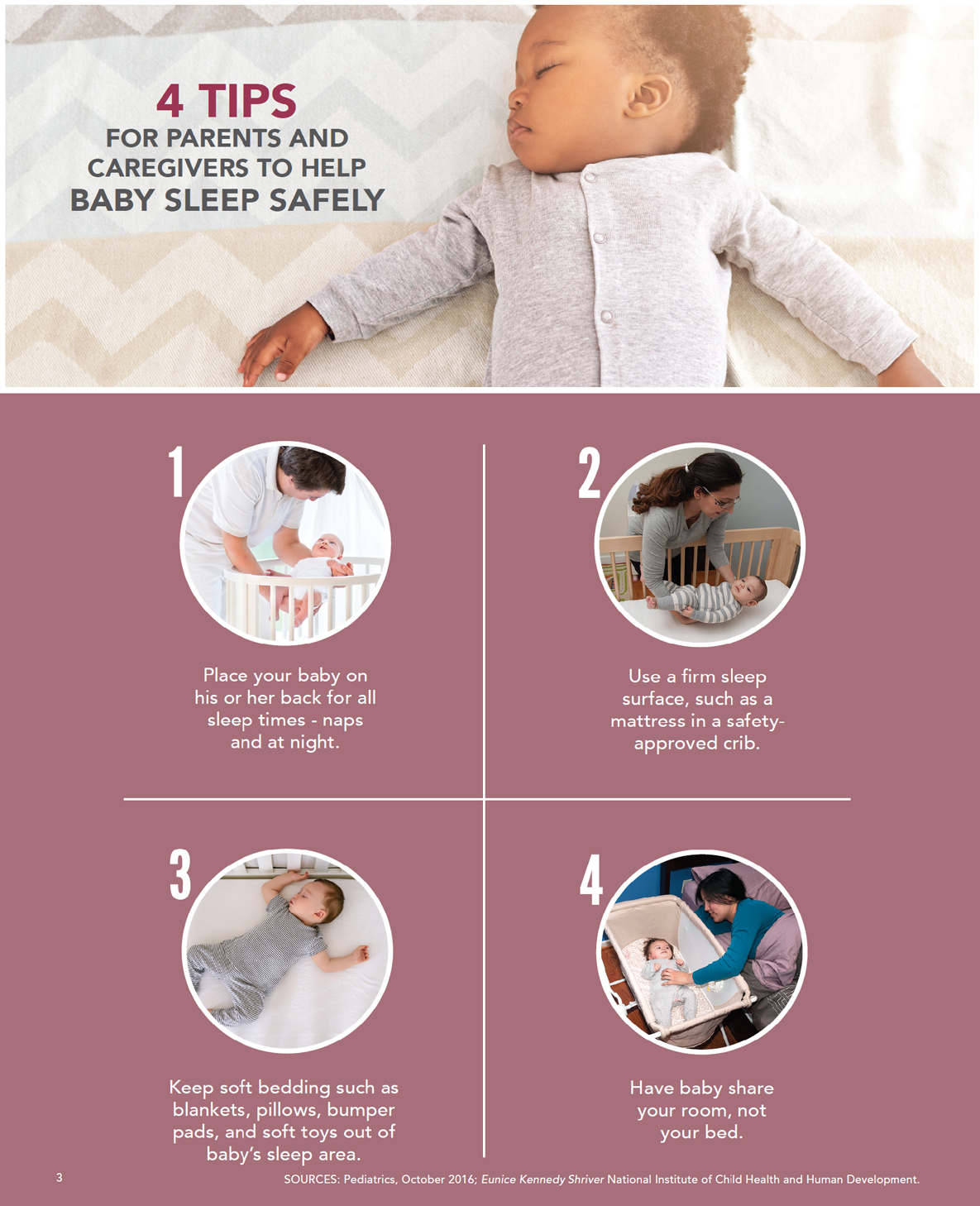
4 Tips for Parents and Caregivers to Help Baby Sleep Safety
1
Place your baby on his or her back for all sleep times-naps and at night.
2
Use a firm sleep surface, such as a mattress in a safety-approved crib.
3
Keep soft bedding such as blankets, pillows, bumper pads, and soft toys out of baby’s sleep area.
4
Have baby share your room, not your bed.
SOURCE: Pediatrics, October 2016; Eunice Kennedy Shriver National Institute of Child Health and Human Development